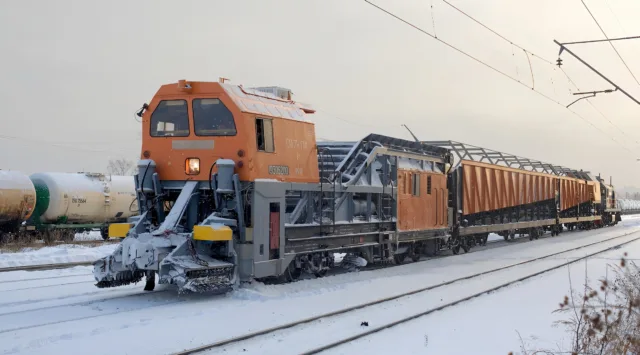
Snow blower SM-7N
Issued in 2004-2023 years. Built 25 car.


SM-2 – Snon-harvest Mfamiliar, type - 2. Issued in 1965-2002 years on Transmash. Built 42 car.
Snowfall is not only a joy for winter sports enthusiasts, but also a serious problem for railway transport. To ensure safe and uninterrupted train movement in winter, effective means for removing snow and ice are needed. One of these tools is the SM-2 snow blower, which has proven itself to be a reliable and effective tool in this area.
SM-2 is a non-self-propelled snow plow, consisting of four carriages, which works in tandem with a freight or shunting diesel locomotive. The first car is the lead one, equipped with all the necessary equipment for snow removal and ice chipping. The removed snow is transferred to gondola cars-conveyors, where is it stored before unloading?. The machine's performance is impressive 1200 m³/hour and allows you to effectively cope with large volumes of snow.
The head car is equipped with a diesel engine, which provides power to the compressor and auxiliary machines. Snow brushes and other mechanisms are controlled using pneumatics. The first and last cars have control cabins for operator control of the cleaning and unloading process. Snow emissions can reach 6 meters, distributing it over large areas.
The car was first produced in 1958 year and has since become widespread in the countries of the former USSR. The main manufacturer is OJSC "Transmash" in the city of Engels, Saratov region.


G – head, P – intermediate
 Belarus: Belarusian railway
 Kazakhstan: Kazakh railways
 Import: Kyrgyz railways
 Latvia: railway of Latvia
 Lithuania: Lithuanian railways
 Moldavia: railway of Moldova
 Russia: East Siberian railway, Gorkovskaya railway, Far Eastern Railway, Zabaikalskaya railway, West Siberian railway, Kaliningrad railway, Krasnoyarsk railway, Kuibyshevskaya railway, Moscow railway, Oktyabrskaya railway, Privolzhskaya railway, Sverdlovsk railway, Northern railway, North Caucasus railway, Yuzhno-Uralskaya railway, Yamal railway
 Slovakia: railway company of Slovakia
 Ukraine: Donetsk railway, Lviv railway, Odessa railway, Pridneprovskaya railway, Southwestern railway, Southern railway
 Czech Republic: Czech railways
 Estonia: Estonian railways


 Open our Telegram chat
Or find a group @railtrain_chat


