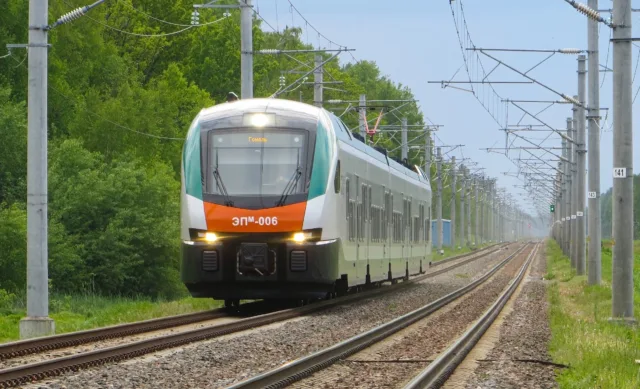
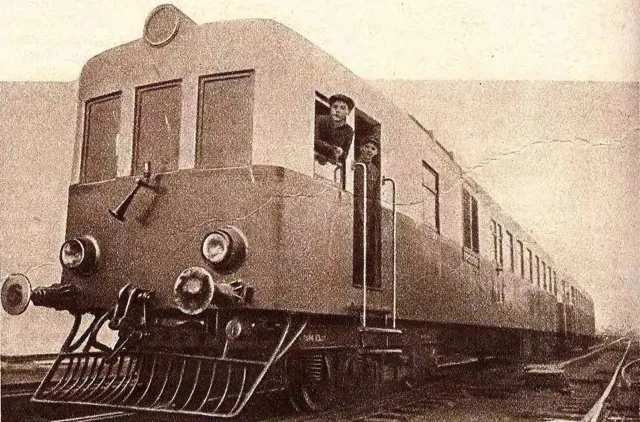
Diesel train DR1
Issued in 1963-1970 years. Built 52 composition.


SVT 137 – Schnell Vcombustion Tfriction pull (Sdry train c Dengine Ininternal combustion), type - 137. Issued in 1935-1936 years on Waggon construction Görlitz. Built 13 compositions.
In the early 1930s, active development of a network of high-speed railway lines between major cities began in Germany.. For their service Deutsche Reichsbahn Gesellschaft (DRG) ordered SVT diesel trains 137, which became a further development of experimental VT 877 "Flying hamburger". In 1933-1934 years were built 13 train series "Hamburg", which laid the foundation for the FDt network (Long distance through train) – long-distance high-speed multiple unit trains.
SVT train 137 consisted of two carriages, connected by a common two-axle Jacobs bogie. The structure had load-bearing beams, smooth body contours and aerodynamic "skirt" to reduce air resistance. The height of the windows has been increased compared to the prototype, and the passage between the cars was closed with a corrugated sleeve.
The power plant included two 12-cylinder Maybach GO diesel engines 5 power 410 hp. and generators AEG aG210/26b. Electric transmission powered two Dx traction motors 1681 power by 230 kW, mounted on drive trolleys under the cabins. The power reserve was provided by three fuel tanks 330 l. The braking system included Hikp drum brakes, Jores-Müller electric brake and after modernization disc brakes.
The passenger compartment had a layout 2+1 with wide aisles and separate compartments. One of the carriages was equipped with a restaurant with a kitchen, buffet and refrigerator. Heating was provided by Narag water heaters, and the on-board network was powered by an auxiliary generator 110 In. The train was equipped with the SIFA security system, INDUSI and internal telephone communication.
The first trains arrived at the stations of Berlin and Hamburg, serving routes Berlin-Hamburg, Berlin-Cologne, Berlin-Frankfurt and Berlin-Nuremberg-Munich. A speed record was set on the Hannover-Hamm line 132,2 km/h. In 1939 operation was suspended due to the war, and trains were used for official transportation.
After the war, part of the trains went to the USSR (2 units) and Czechoslovakia (6 units), where they were operated until the mid-1950s. In the GDR and West Germany, the remaining trains were modernized, including the replacement of diesel engines with Czechoslovakian ČKD and German Maybach. Some were transferred to Czechoslovakia, where express trains were based "Blitzzüge". In the GDR, some trains were converted into three-car trains, and others were used on routes "Vienna" and internal lines.


 Germany: German railway
 Georgia: Georgian railway
 Russia: Moscow railway
 Slovakia: railway company of Slovakia
 Czech Republic: Czech railways
 Open our Telegram chat
Or find a group @railtrain_chat