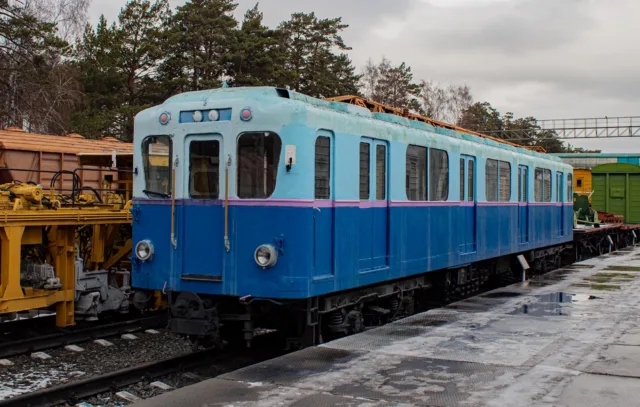
Metrotrain 81-717/714 was seen as a temporary solution , however, its operation dragged on for decades. It is the most common type of metro cars in the post-Soviet space. Name "Nomernoy" got it because, that this series was the first to not have a letter designation, such as, carriages type A, B, In, G, D and E. The option was to continue the tradition and call this type of train a series J.
One of the key features is the absence of a driver's cabin in intermediate cars, which increased carrying capacity by 10%. The driver's cabin has been redesigned: end escape door removed, The driver's console was moved to the center of the cab and the location of the headlights was changed. More powerful traction electric motors DK-117D were also used and the electronic circuit of the train was improved. All head cars are equipped with the ALS-ARS system, have ASNP and driver's crane 013 type (sometimes you can meet 337).
Structurally, the metro train is an intermediate link from metro cars like E. The series was planned for testing equipment, which was to be used in the letter series I. Due to the acute shortage of metro trains with 1976 year carriages 81-717/714 began to be supplied en masse not only to Moscow and St. Petersburg, but also for the border, including Prague metro, Budapest and Warsaw. During its history "License plates" underwent multiple modernizations and major overhauls. However, from the beginning of the 2010s, a gradual replacement of these cars with new metro trains began, For example 81-775 "Moscow 2020" (Moscow) and 81-725.1 "Baltiec" (Saint Petersburg).
Factory designation:
Motor-head – 81-717
Motor-intermediate – 81-714
Peculiarities:
They differed from other subway cars in the absence of a driver's cabin in intermediate cars, eliminating the cabin increased the capacity of the cars by 10%
Driver's seat, and also the train controls have moved from the right side of the cabin to the middle in front of the large wind window
The series was developed at the Mytishchi and Leningrad plants, and the cars were used in the USSR metro and were delivered abroad
It is the most popular and widespread type of metro train in the CIS.
Modifications:
81-717.1 (release 1977-1990 years, built 507 carriages) – export version to Prague
81-717M (modernization in 1996-2011 years) - This 81-717.1,Mmodified by Skoda factory
81-717.2 (release 1979-1991, 1998, 2016 years, built 196 carriages) – export version to Hungary
81-717.2M (built in 1998 year 2 composition) – 5-car trains at the base 81-717.5M sent to Budapest
81-717.2K (modernization in 2016-2018 year, 222 carriage) – Hungarian carriages after Kcapital repairs
81-717.3 (release in 1989 and 2007 years, built 35 carriages) – export version for Poland
81-717.4 (release 1990 year, built 12 carriages) – export version for Bulgaria
81-717.4K (modernization with 2019 year, 8 carriages) – major overhaul of Bulgarian 81-717.4
81-717.5 (release 1988-2007 years, built 1593 carriage) – reinforced carts, increased fire safety
81-717.5A (release 2010 year, built 7 carriages) - this is stylized 81-717.5M under the retro series A
81-717.5B (release 2002-2011 years, built 165 carriages) – export option to Azerbaijan (Baku)
81-717.5M (release 1997-2010 years, built 1588 carriages) – MOskovsky version
81-717.5P (release 2011-2014 years, built 206 carriages) – for St.-PPetersburg with an updated driver's cabin, almost analogue 81-540.2
81-717.6 (release 2006-2013 years, built 158 carriages) – changed cabin and appearance, is a transitional model to 81-760 "Oka"
81-717.6K (with 2009 modernized 206 carriages) – carriages 81-717.5 after Kcapital repair transitional model to 81-760 "Oka"
81-717 0041
Numbers 8469, 8871, 8834 and 8595
81-717 9259
81-714.5M salon
81-717 driver's console
Specifications:
G – head, P – intermediate
Capacity – 2×309 people. (G) and N×330 people. (P)
sedentary – 2x42 seats (G) and N×48 seats (P)
Height – 3650 mm
Length – N × 19 206 mm
Width – 2670 mm
Track – 1435, 1524 mm
Design speed – 90 km/h
Minimum curve radius – 60 m
TEM power – N × 4 × 118 kW (N×472 kW)
Type TED – collector, DK-117D
Acceleration – 1,2 m/s2
Type of current – variable (380 In), constant (825 In)


 Azerbaijan: Baku
 Armenia: Yerevan
 Belarus: Minsk
 Bulgaria: Sofia
 Hungary: Budapest
 Georgia: Tbilisi
 Poland: Warsaw
 Russia: Yekaterinburg, Moscow, Nizhny Novgorod, Novosibirsk, Samara, Saint Petersburg
 Uzbekistan: Tashkent
 Ukraine: Dnieper, Kyiv, Kharkov
 Czech Republic: Prague
 Open our Telegram chat