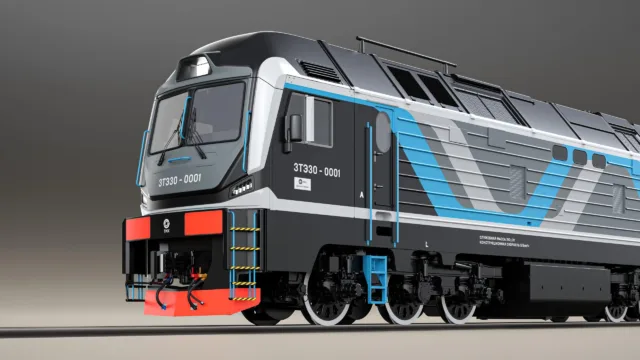
Locomotive 2TE30
Could be issued with 2025 year. Project.


O – steam locomotive Omain. Issued in 1890-1928 years on BMAG (Schwartzkopff), Henschel, Austrian Society, Bryansk Machine-Building Plant, Votkinsk plant, Zigl, Kirov plant, Kolomna plant, Lugansk Diesel Locomotive Plant, Nevsky plant, Sormovo plant and Kharkov Transport Engineering Plant. Built 9129 steam locomotives.
O series locomotive approved in 1890 year as the standard type of locomotive for state and private railways of the Russian Empire. Its creation was driven by the need to unify the fleet: engineers needed a universal device, capable of working on different types of tracks, transport as cargo, and passengers, and also have the potential for modifications.
The O series design was based on a steam locomotive "government reserve" (type Chk), but has undergone significant changes. The Allan steam distribution machine was replaced by a more easy-to-repair Joya system with an external rocker., The steam pressure in the boiler was increased to 11 kgf/cm² and the type of steam engine was changed to compound. First modifications (types 39 and 40) launched into production by Kolomna Plant. Thanks to its robust design and optimal axial load, series O became the most popular among pre-revolutionary locomotives, having received nicknames among railway workers "lamb" and "joy".
The locomotive belongs to the axial scheme 0-4-0 with four moving axes. The design involves the use of a steel multi-layer frame, providing high rigidity. The boiler consists of 4 overlapping drums; its design assumed the possibility of changing volumes and dimensions if modernization was necessary.
The basis of the traction system is the compound machine, where the steam passes through 2 cylinders of different diameters (high and low pressure). This scheme ensured high efficiency of fuel combustion. During the development of the series, various steam distribution mechanisms were used in some modifications (Valsharta) and set additional parameters, such as increasing the boiler heating area or using special pipes. Durable materials and a large margin of safety of parts allowed the locomotives to operate on various types of fuel: coal, fuel oil, peat and wood.
During the operation of the O series, various modifications were identified depending on the design features. Od steam locomotives received due to Joy's rocker mechanism and reduced wheel diameter (1150 mm), steam locomotive Ov - thanks to the introduction of the Walshart mechanism, and the Op series marked the transition to the use of superheated steam.
Thanks to low axle load, O series locomotives became the main locomotives for armored trains during the Civil and Great Patriotic Wars. Compact dimensions and high reliability allowed them to work on light tracks and under conditions of increased load from protective armored screens. During the Soviet period, a series of steam locomotives remained the main traction on main and secondary lines, providing freight services until the mid-1960s. Even after retirement from active use on main routes, representatives of the series continued to serve in shunting work and in the industrial sector.


 Belarus: Belarusian railway
 Germany: German railway
 Georgia: Georgian railway
 Kazakhstan: Kazakh railways
 Latvia: railway of Latvia
 Lithuania: Lithuanian railways
 Poland: Polish state railways
 Russia: Gorkovskaya railway, Zabaikalskaya railway, Krasnoyarsk railway, Kuibyshevskaya railway, Moscow railway, Oktyabrskaya railway, Sverdlovsk railway, Northern railway, South-Eastern railway
 Uzbekistan: Uzbek railway
 Ukraine: Pridneprovskaya railway, Southwestern railway, Southern railway
 Estonia: Estonian railways

 Open our Telegram chat
Or find a group @railtrain_chat


