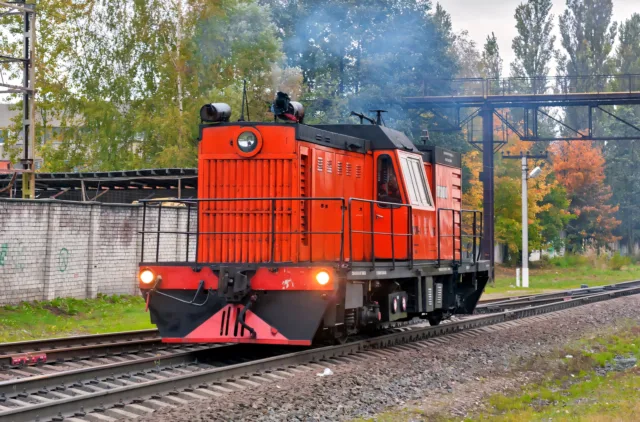
Parovoz Y
Issued in 1910-1920 years. Built 372 locomotive.


Su – steam locomotive SOrmovsky plant, Ustrong. Issued in 1924-1951 years on Bryansk Machine-Building Plant, Kolomna plant, Lugansk Diesel Locomotive Plant, Sormovo plant and Kharkov Transport Engineering Plant. Built 2683 locomotive.
After the end of the First World War, the production of passenger steam locomotives in Russia was suspended, and the emphasis shifted to the production of trucks of the series Ye. In the period after the Civil War the situation changed: the growth of passenger traffic with the impossibility of raising tariffs forced the People's Committee of Railways (NKPS) move to increasing train capacity instead of increasing the number of trains. This required the introduction of steam locomotives, capable of pulling heavier trains and running efficiently on low-grade coal. This required an increase in the area of the grate and the corresponding weight of the combustion part of the boiler.
In 1923 year plant "Red Putilovets" began work on a project for a powerful three-cylinder steam locomotive of the type 2-4-0 under the leadership of A.S.. Raevsky, however, due to the complexity of the design and the tragic death of the designer, the project was not completed on time. In conditions of time shortage and the need to quickly develop production capacities, NKPS was looking for a solution among already familiar types of machines. Initially, steam locomotives of the series were considered S (type 1-3-1), but they are considered unsuitable for working with cheap fuel due to the small volume of the firebox.
The design of a more advanced courier locomotive of the series was chosen as the basis Sv. It had the necessary design advantages: trolley system "Krauss-Helmgoltz" instead of "Cara-Kraus", rear support axle on the trolley "Bissel" and an enlarged combustion part. Based on this prototype in 1924 year at the Kolomensky plant under the leadership of P.I.. Takhtaulov developed a solution to create a new steam locomotive - the Su series. The design was carried out by a group of specialists, including K.N. Sushkina and V.E. Khlebnikov, who were responsible for creating a boiler with an increased firebox while maintaining the ability to use existing production dies.
The Su steam locomotive became the first universal steam locomotive in the USSR, equally suitable for high-speed and heavy passenger trains. The main engineering challenge was to increase the heating surface of the boiler and the power of the superheater while maintaining permissible axle loads (to 17,5 T). During design compared to prototype Sv the following changes have been implemented: increasing the area of the grate with 3,8 m² to 4,73 m², transition from a four-pipe Schmidt superheater to a six-pipe Chusov system and an increase in operating steam pressure from 12 to 13 kgf/cm².
During mass production, the Su design evolved through 5 design options. Options 1925 and 1926 years (types 152 and 162) solved problems of weight distribution and ensuring the possibility of operation as on coal, and on oil - for this purpose it was possible to install a slow firebox. During these modifications, the length of the smoke box was reduced and the boiler service conditions were optimized.
Project 1932 year marked a transition to wider use of welding in production, simplifying the design of the gable plate of the smoke box and replacing the copper whistle with a standardized cast iron one. Option 1934 included a significant expansion of functionality: The volumes of the sand bunker and coal bunker were increased, an ash pit scheme for a two-hopper system was introduced, and also provides a more advanced spring suspension and reinforced elements of the front buffer beam. Final changes to 1947 assembled at the Sormovo plant, where the combustion frame components were optimized, a double-acting locomotive pump of the Rudenko system was introduced and the characteristics of the wheel sets were updated.
The steam locomotive Su began to arrive on the line in 1925 year, quickly becoming the most common standard passenger locomotive on Soviet railways in the 1930s. It was valued for its high supply of steam with moderate fuel consumption, even under conditions of intense boiler operation.. In 1932 year, with the advent of a more powerful steam locomotive of the series IS, Su's category was changed from "powerful" on "medium power".
During the Great Patriotic War, machines of this series were used to ensure the operation of ambulance trains. In the post-war period, work on Su steam locomotives became a sign of the high skill of drivers with extensive experience. Steam locomotives of this series remained on main lines until the end of the 1960s, and on minor ones until the end of the 1970s. In terms of their operational and economic indicators, later modifications of the Su steam locomotive are fully consistent with the best world models of passenger cars of their time.


P – steam locomotive, T – tender
 Belarus: Belarusian railway
 Kazakhstan: Kazakh railways
 Latvia: railway of Latvia
 Mongolia: Ulaanbaatar railway
 Russia: East Siberian railway, Gorkovskaya railway, Far Eastern Railway, Zabaikalskaya railway, West Siberian railway, Kaliningrad railway, Krasnoyarsk railway, Moscow railway, Oktyabrskaya railway, Privolzhskaya railway, Northern railway, North Caucasus railway, South-Eastern railway, Yuzhno-Uralskaya railway
 Uzbekistan: Uzbek railway
 Ukraine: Donetsk railway, Lviv railway, Odessa railway, Pridneprovskaya railway, Southern railway
 Estonia: Estonian railways

 Open our Telegram chat
Or find a group @railtrain_chat